
Why the Return of Jesus Christ Is a Real Event That Will Reoccur!!

Updated: May 18
This post is my personal belief, testimony, and interpretation of spirituality, science, consciousness, parenting, sobriety, and the return of Jesus Christ.
Understanding Truth
Why the Return of Jesus Christ Is a Real Event That Will Reoccur
I want to make a post about how Jesus Christ can be recreated. I believe it would take a certain individual, such as an earthly father, who is aware of his ability to create reality. That individual would need to have a deep understanding of how balance works. Basically, the father of Jesus Christ would have had to go through actual hell on earth, survive it, heal from it, and enter heaven on earth.
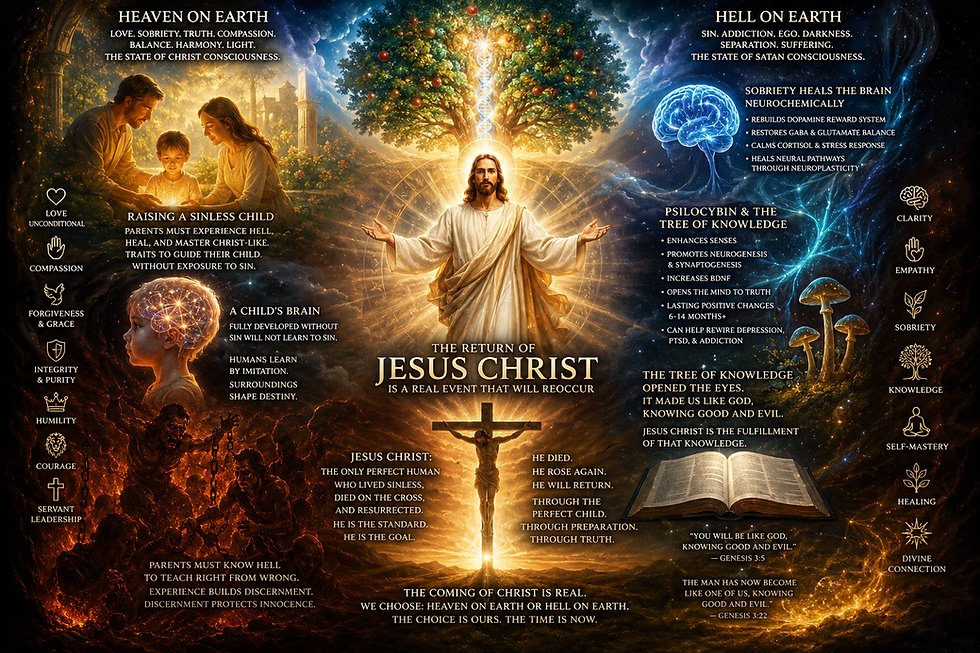
I believe the only way an individual could recreate Jesus Christ would be by teaching their child only correct ways of being and living, never exposing the child to sin, and ensuring both parents are fully prepared and actively practicing the traits of Jesus Christ. The son of those parents would ideally never be exposed to sin.
The reason it is important for the parents to previously experience hell is so they can truly know right from wrong and choose to steer clear of all sin and darkness. Going through hell can equip an individual to never want to return to that state of mind and to gain knowledge of what truly represents heaven on earth.
Without going through hell and learning what substances, chemicals, post-personality traits, and destructive behavioral patterns occur from practicing a false self, the possibility of the parents making a mistake increases significantly. It is also important for the parents to have knowledge of what hell on earth truly represents. Without that understanding, parents cannot fully equip their child with the correct methods needed to recreate a perfect person.
If a child’s brain is fully developed without ever being exposed to sin and the child chooses to continue practicing the personality of Christ, then the child’s brain will never learn to sin or give into fleshly desires. This is why it is very important for parents to truly understand which state of mind represents Christ and which state of mind represents Satan.
Humans learn from their surroundings, which is exactly how the brain of Jesus Christ worked. Humans are deeply hardwired to learn by imitation. It is one of our most fundamental tools for skill development and cultural transmission. By watching and mimicking others, humans avoid the slow and laborious process of trial and error while rapidly acquiring complex abilities such as language, motor skills, and social customs.
With that being said, if a human brain is fully developed and equipped with the personality of Jesus Christ, while surrounded by parents who have also achieved the Christ state, then the chances of the return of Jesus Christ become more likely.
Let us focus on the scientific aspects of this situation. To understand what state of mind represents Jesus Christ, individuals should understand that sobriety, clarity, compassion, and empathy, which Jesus Christ possessed, can also be practiced by individuals who allow their human emotions to fully develop.
Actively practicing sobriety helps individuals understand the emotions of Jesus Christ. Understanding what resources represent human consciousness is also important for parents who plan on trying to recreate the personality of Jesus Christ to the best of their abilities, which is what every parent should aim to create.
The reason for this is because Jesus Christ is the standard we use to describe what a perfect person actually is. Parents should strive, to the best of their abilities, to recreate individuals who hold the traits of Jesus Christ.
The traits of Jesus Christ include:
Core Virtues and Emotions
Unconditional Love (Agape)
Jesus demonstrated deep, selfless love for all people, putting the needs of others before His own and seeking the ultimate good for everyone.
Joy and Peace
He possessed a deep rooted sense of inner calm and spiritual joy, even in the midst of extreme adversity and stress.
Humility
Despite having unmatched authority, He was completely free of arrogance, famously serving others and washing His disciples’ feet.
Purity and Integrity
He lived a completely righteous life, and His internal motives and external actions were always in perfect alignment.
Social and Relational Characteristics
Compassion
He was deeply empathetic to the physical, emotional, and spiritual suffering of those around Him, frequently pausing to help the marginalized.
Forgiveness and Grace
He offered forgiveness freely, famously showing mercy even to those who wronged Him, and taught others to do the same.
Gentleness and Kindness
He was approachable and kind, treating the disadvantaged, children, and outcasts with profound respect.
Strength and Leadership Traits
Courageous Conviction
He was unyielding in the face of injustice and religious hypocrisy, boldly defending the truth regardless of opposition.
Perfect Wisdom
He balanced boldness and gentleness with flawless timing, knowing exactly when to teach, encourage, or correct those around Him.
Servant Leadership
He redefined leadership as an act of service rather than lording power over others, modeling a lifestyle of self sacrifice.
Who in their right mind would want to create anything besides that?
To practice the personality of Jesus Christ, it is very important for parents to understand what sobriety means on a neurochemical level.
On a neurochemical level, sobriety is not just the absence of a substance. It is a profound process of biological healing and adaptation. When you stop using addictive substances, your brain undergoes an active, sometimes uncomfortable recalibration to restore its natural chemical balance.
Rebuilding the Reward System (Dopamine)
The Impairment
Chronic substance use forces unnaturally massive dopamine spikes in the brain’s reward center, known as the nucleus accumbens. To compensate, the brain shrinks or reduces its dopamine receptors.
Sobriety’s Role
Without artificial surges, this reduced receptor state causes early sobriety feelings of anhedonia, which is the inability to feel pleasure. Over time, these receptors upregulate, or grow back, allowing the brain to experience normal rewards from everyday activities.
Restoring Inhibitory Control (GABA and Glutamate)
The Impairment
Substances such as alcohol artificially boost GABA, the brain’s primary calming chemical, while suppressing glutamate, which drives alertness and excitation. The brain compensates by becoming hyper excitable.
Sobriety’s Role
Once the substance is removed, glutamate runs wild without enough GABA to balance it, triggering hyperexcitability, anxiety, and insomnia. Sobriety allows these systems to reset to a natural equilibrium, gradually eliminating withdrawal induced anxiety.
Calming the Stress Response (Cortisol and CRF)
The Impairment
Prolonged substance use chronically over activates the brain’s stress systems, including the extended amygdala.
Sobriety’s Role
During abstinence, stress chemicals such as corticotropin releasing factor and cortisol slowly diminish, lowering baseline anxiety and the physiological urge to use substances to cope with negative mood states.
Healing Brain Structure (Neuroplasticity)
The Healing
Sobriety allows neuroplasticity to work in reverse of addiction. While active substance use damages neural pathways and shrinks brain volume, sustained abstinence allows nerve cells to return to normal volume and synapses to regrow.
It is also important for parents who aim to bring the personality of Jesus into their surroundings to understand what natural resources outside of the self may represent healing and Christ consciousness.
Healing has everything to do with Jesus Christ. Understanding what natural resources can heal the brain can help families practice the personality of Jesus Christ.
The true personality of Jesus Christ has a lot to do with the Tree of Knowledge. This concept appears in Genesis Chapter 3.
In Genesis 3:5, the serpent tempts Eve by saying:“For God knows that when you eat from it your eyes will be opened, and you will be like God, knowing good and evil.”
In Genesis 3:22, after they have eaten the fruit, God confirms the change by saying:“The man has now become like one of us, knowing good and evil.”
I believe this biblical teaching specifically connects to Jesus Christ because Jesus Christ is the smartest and most knowledgeable individual to ever walk the earth.
I believe there is a secret Tree of Knowledge that enhances the senses so neuropathways work more efficiently and potentially help heal many illnesses. I believe the effects generated by the Tree of Knowledge are connected to the same personality traits that Jesus Christ and God Himself hold.
People need to understand that Jesus was God and He was also human. If you are aware enough of the reality we live in, you can begin to put the pieces together and realize that humans are also a part of God because we are God’s creation.
Those who practice the personality of Satan are often unaware of this and live on a level of existence that does not represent true understanding. Those who practice the personality of Jesus Christ have a better understanding that God is omnipresent.
Omnipresent means that God is everything, everywhere, and within all existence, including all of us.
God is not merely an entity located in the sky. God is the ultimate reality in which all things exist. In this view, God is the air creation breathes, sustaining every atom, star, and living being through His continuous will.
God transcends physical space and time while also being fully present within every element of creation.
Understanding God as both the omnipresent creator and the embodiment of all realities, including heaven and hell, is essential.
Heaven is not only a future destination. Heaven is the active presence of perfect love, peace, grace, and ultimate truth. In heaven, the presence of God is experienced in its fullness, resulting in eternal joy and harmony for those who align with the divine jurisdiction of Jesus Christ and His teachings.
Because God is omnipresent, He is also present in hell. However, His presence is experienced differently there.
Hell is the natural consequence of rejecting the divine. To those who are hostile toward love and goodness, the perfect presence of God feels agonizing and like righteous wrath.
In this sense, God represents hell by being the objective standard of ultimate good against which the unredeemed soul experiences constant friction.
Creation contains a vast hierarchy of personalities, including humans, angels, and demons, all granted free will. Personalities exist on a sliding scale based on alignment with God’s nature.
Those who align with love and selflessness move toward the heavenly reality. Those who embrace pride, hatred, selfishness, and alienation from the divine move toward the reality of hell.
This is why I believe the return of Jesus Christ is a real event that will reoccur.
If my son chooses not to sin, as I will give him free will, then I plan to change my last name to Christ because I will also choose not to sin. I would name my first sinless son Jesus. He would be Jesus Christ, and he would be a perfect person. He would realize this for himself, and it would ultimately be his own choice.
I believe that after this occurs, he may willingly choose to die on a cross because he would understand that he could live again with the same memories and same vessel three days later.
To me, this explains that Jesus Christ was not a regular human being. He was God who mastered perfection and chose not to sin, the healthiest being to ever live on earth, with the supernatural capability to resurrect Himself and others from the dead.
I believe this was prophesied by the mushroom.
In 2018, I had an experience where mushrooms left me with the realization that we are all God and that I had become deeply aware of this concept. I felt I learned how to embody Christ at His highest form of existence.
This experience left me with knowledge about how to become more Christ like.
By taking magic mushrooms, I believe individuals can become more like Jesus Christ because the experience can heighten awareness, increase sensitivity to surroundings, and encourage deeper introspection.
People claimed I was crazy in 2018 for consuming extremely high doses of magic mushrooms. I do not believe I was crazy. I believe I became deeply aware of truth and developed a stronger understanding of how to become more Christ like.
My entire life has been devoted to this message. Ever since I ate from what I believe is the true Tree of Knowledge, I have devoted myself to proving that sobriety has everything to do with the personality of Jesus Christ.
The coming of Christ is real.
If someone has the free will to live in hell on earth, then we also have the free will to live in heaven on earth.
Research suggests that positive personality shifts from psilocybin, such as increased openness to new experiences, may last between six and fourteen months, with some benefits enduring for over a year. Studies also suggest that psychedelics may temporarily increase neuroplasticity and emotional openness.
Research from Yale and other institutions has explored how psilocybin may increase dendritic spine growth, neural connectivity, and brain derived neurotrophic factor, often referred to as BDNF.
At their core, the teachings of Jesus Christ and the effects of psilocybin both center around ego dissolution, interconnectedness, radical compassion, forgiveness, death and rebirth, and spiritual transformation.
Jesus taught individuals to deny selfish desires and surrender to a higher spiritual purpose.
Psilocybin experiences are often described as temporarily dissolving the ego and increasing feelings of unity and interconnectedness.
Jesus taught radical love, compassion, forgiveness, and service toward others.
Many psilocybin users report increased empathy, openness, emotional sensitivity, and spiritual insight.
Jesus taught death and resurrection.
Psilocybin experiences are often described as psychological death and rebirth experiences.
While these similarities exist, their contexts differ significantly. Traditional Christianity teaches that transformation comes through the Holy Spirit and a relationship with Jesus Christ, while psychedelic experiences are interpreted by some individuals as tools that help reveal similar states of consciousness.
I believe my mission is to become as Christ like as possible and prepare the way for the return of Jesus Christ.
Stay tuned to hear about the detailed experiences that helped me realize my life mission is to become as Christ like as possible.
Please consider donating and supporting this mission, as I also have to live and survive within this world while dedicating my life to spreading this message. Every form of support helps me continue researching, creating content, sharing my experiences, and pursuing my mission of becoming as Christ like as possible while helping others seek healing, truth, love, sobriety, and spiritual growth.


Comments